The World Bank Group’s regional update published on October 6 shifts the immediate economic question from whether the Middle East conflict is costly to who is absorbing the biggest near-term loss. Its answer is not the whole region equally. The Bank says output across the Middle East, North Africa, Afghanistan, and Pakistan is projected to shrink 2.1 per cent in 2026 after 3.3 per cent growth in 2025, with the steepest damage concentrated in oil-exporting Gulf economies affected by the closure of the Strait of Hormuz. World Bank regional update, Oct. 6
That asymmetry is the most important point in the record. The same World Bank release projects Gulf Cooperation Council economies will contract by an average of 4.3 per cent in 2026, while oil-importing countries in the region are projected to grow 4.3 per cent. The Bank also ties the shock to specific channels: lower hydrocarbon exports, disruption to tourism, aviation and logistics, pressure on financial markets and business sentiment, and higher shipping costs feeding food-price inflation. Taken together, those projections suggest the main problem is not simply regional uncertainty. It is the interruption of routes and volumes that some economies rely on most heavily. World Bank regional update, Oct. 6
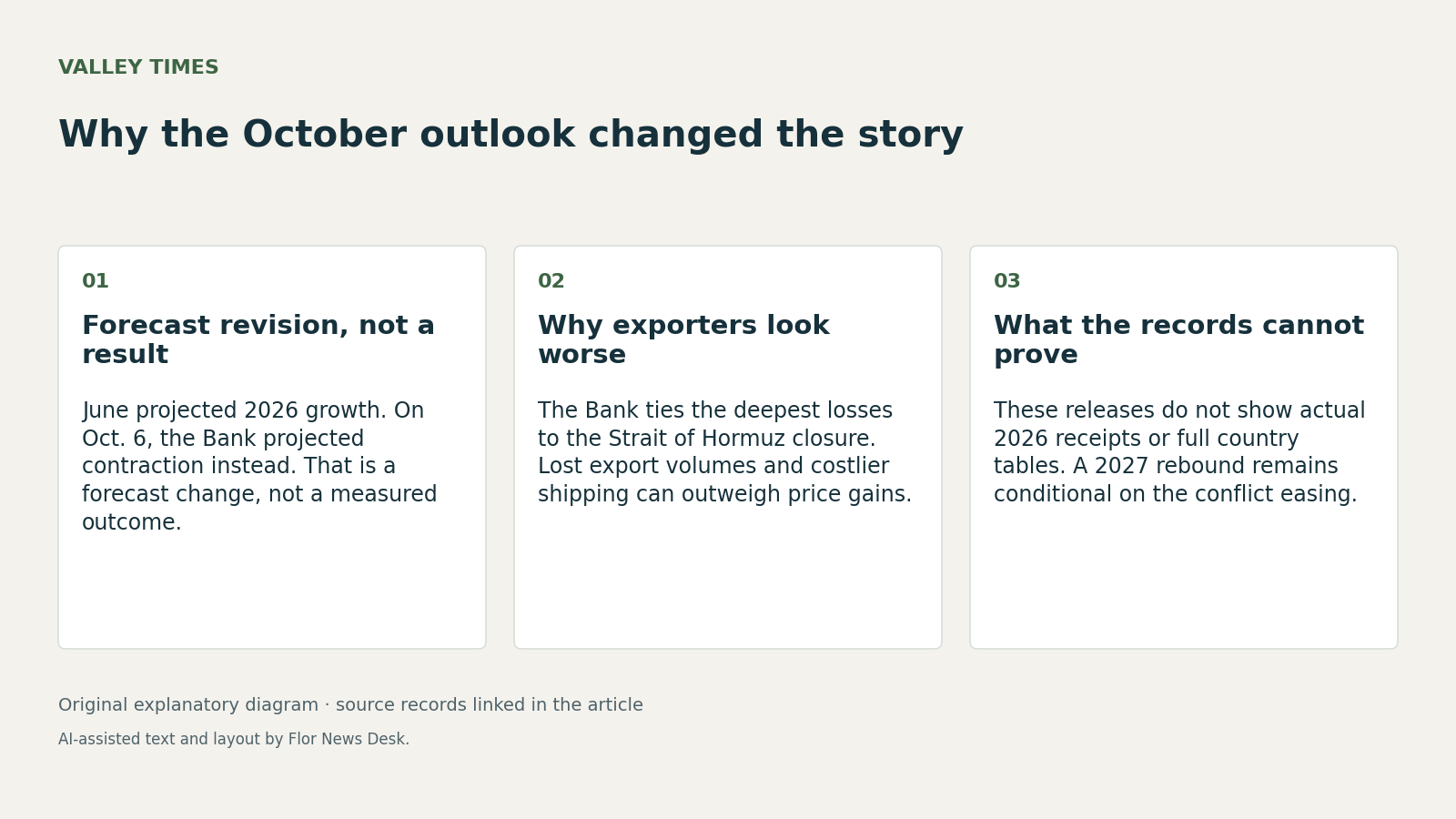
The October numbers also matter because they are noticeably worse than the Bank’s earlier public forecast. On June 11, in its Global Economic Prospects release, the Bank had forecast 2026 growth of 1.6 per cent for the same broad region and a 2027 recovery to 5.0 per cent. That June release said Gulf economies directly affected by the conflict were expected to slow to around zero growth in 2026, under an assumption that the worst energy-market disruptions eased in July. By October, the Bank was instead projecting a regional contraction and a deeper hit to Gulf exporters. That does not prove what happened month by month. It does show that the Bank’s own public outlook deteriorated sharply between June 11 and October 6. World Bank global outlook, June 11 World Bank regional update, Oct. 6
The limits of those records are just as important. The October item is a press release summarizing a regional update, not a measured 2026 outcome. It does not provide country-by-country tables in the release text. Its 2027 rebound projection, 7.8 per cent growth for the region excluding Iran, is explicitly conditional on the conflict subsiding by the end of 2026. The June record is even more time-sensitive: its language about disruptions easing in July is now only an earlier expectation, not evidence that the easing happened or failed to happen. World Bank regional update, Oct. 6 World Bank global outlook, June 11
A second limit concerns money. The June release said the World Bank Group was making up to US$50 billion to US$60 billion available immediately through existing instruments and could scale support to US$80 billion to US$100 billion over 15 months if the conflict persisted. Those figures describe announced capacity and possible scaling, not money shown in these records as approved, disbursed or received. For readers trying to judge what changes next, the best signals in the source record are practical ones: whether export flows recover, whether shipping costs ease, whether food-price pressure cools, and whether financing moves from availability claims to documented delivery. World Bank global outlook, June 11 World Bank regional update, Oct. 6
The clearest analytical takeaway, based on these two World Bank records alone, is that higher oil prices are not enough to protect exporters when the export route itself is disrupted. That is narrower than a claim about the region’s final 2026 outcome, and more useful than a generic warning about conflict. The Bank’s October update identifies the mechanism, revises its own earlier expectations and leaves the decisive unanswered question for later records: how much of this projected damage becomes measured loss.