Langley riders got the most clearly documented Fraser Valley transit change of early September when TransLink’s fall service update took effect on Sept. 7, 2026: a new weekday Route 556 between Langley Centre and the Gloucester Industrial Area, plus targeted frequency improvements on existing routes used by Langley-area commuters (TransLink service changes, TransLink Aug. 24 release).
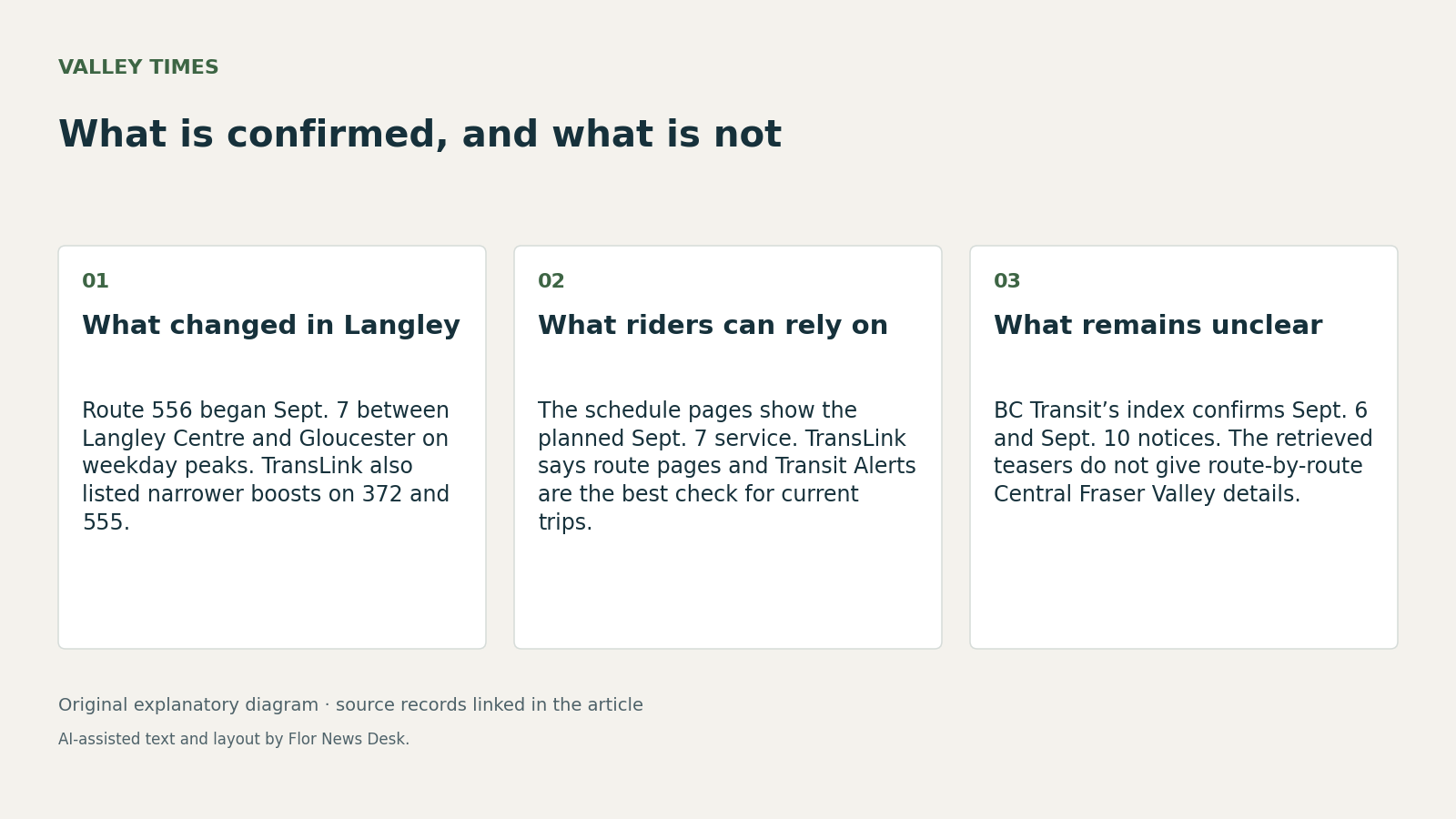
The new Route 556 appears designed first for work trips, not broad all-day coverage. TransLink’s service page says it runs every 30 minutes on weekdays during morning and afternoon peak periods, serves 12 new bus stops in Gloucester, and uses Bay 1 at Langley Centre (TransLink service changes). In its Aug. 24 announcement, TransLink said the route would be the first bus service into Langley Township’s Gloucester Industrial Area and described it as an early delivery from the 2025 Investment Plan (TransLink Aug. 24 release). That is a meaningful local addition, but the record supports a narrow conclusion: new access exists on a peak-only weekday schedule. It does not yet establish how reliable the service has been since launch or how many workers are using it.
The other Langley-side changes are more modest than a general phrase like “boosted service” can imply. For Route 372 toward Langley Centre, TransLink says weekday afternoon service from 2 p.m. to 3 p.m. improved to every 20 minutes from every 30 minutes. For Route 555 toward Carvolth Exchange, TransLink says weekday afternoon and early evening service improved, including every eight to nine minutes from 4 p.m. to 6 p.m., compared with every 10 minutes before (TransLink service changes). Those are useful improvements, but they are still time-window changes, not proof of a system-wide frequency jump across the Fraser Valley.
For riders trying to plan trips, TransLink’s own records draw an important distinction between scheduled service and real-time conditions. Its regional schedules page says public timetables are effective Sept. 7, 2026, but also says route-specific schedule pages are the most accurate source and directs customers to Transit Alerts for last-minute disruptions (Schedules by Region). That means the best-supported practical advice from the source record is simple: treat the September timetables as the planned baseline, then check route pages and alerts for actual daily operation.
BC Transit’s Central Fraser Valley postings point to other changes in Abbotsford, Mission, Chilliwack and surrounding service, but the retrieved material is less complete. The public index lists an Aug. 24, 2026 item for a fall service and fare change effective Sept. 6, 2026; an Aug. 21 item on a new transit exchange near Highstreet Shopping Centre on Mt. Lehman Road; and a Sept. 10 item saying new handyDART booking and trip-management tools are now available in the Chilliwack and Central Fraser Valley Regional Transit Systems (BC Transit Central Fraser Valley news index). But the index teasers do not provide route numbers, fare amounts, stop layouts or exchange opening details, so they are not enough on their own for a reliable route-by-route explainer.
The strongest evidence, then, is not that Fraser Valley transit changed everywhere at once. It is that TransLink published precise, implemented Langley-area changes for Sept. 7, while BC Transit’s retrieved public index confirms separate Central Fraser Valley announcements without enough detail yet to measure their full rider impact. For Valley Times readers, that is the key distinction between a timetable change that can be checked stop by stop and a regional notice that still needs fuller public documentation.