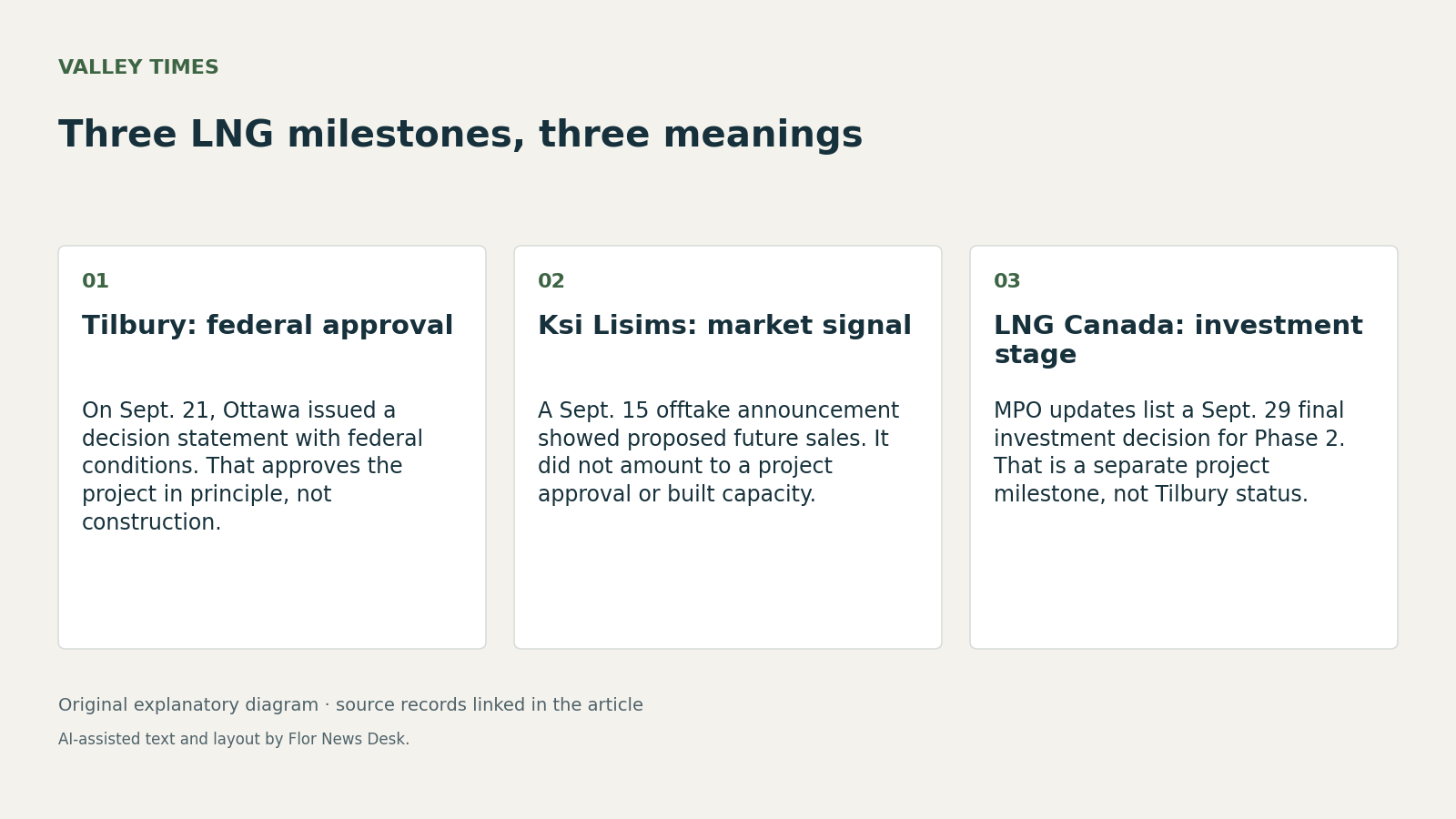

On Sept. 21, 2026, the federal government cleared an important hurdle for the Tilbury Phase 2 LNG Expansion Project in Delta, B.C., when the Impact Assessment Agency of Canada said Minister Julie Dabrusin had issued a decision statement for the project. The agency said the minister found the project’s potential adverse effects within federal jurisdiction were justified when weighed against its benefits, and the agency’s media index separately lists that item as a Sept. 21 news release. That establishes a formal federal approval decision. It does not, by itself, establish when construction begins or whether the project’s promised benefits will materialize. Impact Assessment Agency release IAAC media room index
The release describes FortisBC Holdings Inc.’s proposal as an expansion of the existing land-based Tilbury liquefied natural gas facility on an operating industrial site, adding liquefaction and storage capacity. It also says the decision statement carries legally binding federal conditions that apply through the life of the project, alongside provincial requirements. That matters because the federal record here is not just a news announcement about policy intent. It is Ottawa saying yes, but yes with enforceable conditions attached. Impact Assessment Agency release
The more revealing part of the record is procedural. The agency says the review was a substituted impact assessment conducted by British Columbia under the Impact Assessment Cooperation Agreement Between Canada and British Columbia, in what it describes as a one-project, one-review process. In plain terms, Ottawa relied on a provincial-led assessment process while still issuing its own federal decision and conditions. That is a significant sign of how the federal government can try to move major projects without abandoning federal jurisdiction. But the same release does not supply the full text of the conditions, and it does not prove later milestones such as financing, marine shipping approvals or a build schedule. Impact Assessment Agency release
The record also shows why readers should separate consultation from outcomes. The agency says the assessment process was informed by consultation with 41 Indigenous groups represented by 21 Indigenous organizations. That is an important part of the assessment history. Still, this source record does not establish any final benefit agreements, equity ownership or delivered economic returns for Indigenous nations or organizations. Approval, consultation and realized benefits are different stages, and this release only documents the first two. Impact Assessment Agency release
If the federal government’s September LNG messaging looks unusually concentrated, the public record supports that impression, but only if each milestone is kept in its lane. On Sept. 15, Natural Resources Canada highlighted Ksi Lisims LNG’s third international offtake announcement, saying the proposed north-coast B.C. project had signed a Heads of Agreement with Santos for 1 million tonnes per annum for 20 years after earlier 2026 deals with Uniper and SEFE. That is evidence of market positioning and federal export messaging. It is not a Tilbury approval, and it is not proof that LNG export capacity has been built. Natural Resources Canada release
A separate federal page on LNG Canada Phase 2 shows yet another kind of milestone. The Major Projects Office page says LNG Canada Phase 2 was among the projects to be accelerated under the Canada-British Columbia Cooperative Prosperity Agreement signed July 2, 2026, and its updates section says LNG Canada announced a Final Investment Decision on Sept. 29, 2026. That is a project-sanction and capital-commitment milestone for a different facility in Kitimat, not a proxy for Tilbury’s status. Read together, these records show Ottawa pushing LNG on several tracks at once: regulatory approval for Tilbury, export-deal promotion for Ksi Lisims and investment-stage tracking for LNG Canada Phase 2. The key analytical point is that those are not interchangeable signs of completion. Tilbury’s Sept. 21 decision answers whether Ottawa will allow the project subject to conditions. It does not answer what happens next on the ground. Major Projects Office page