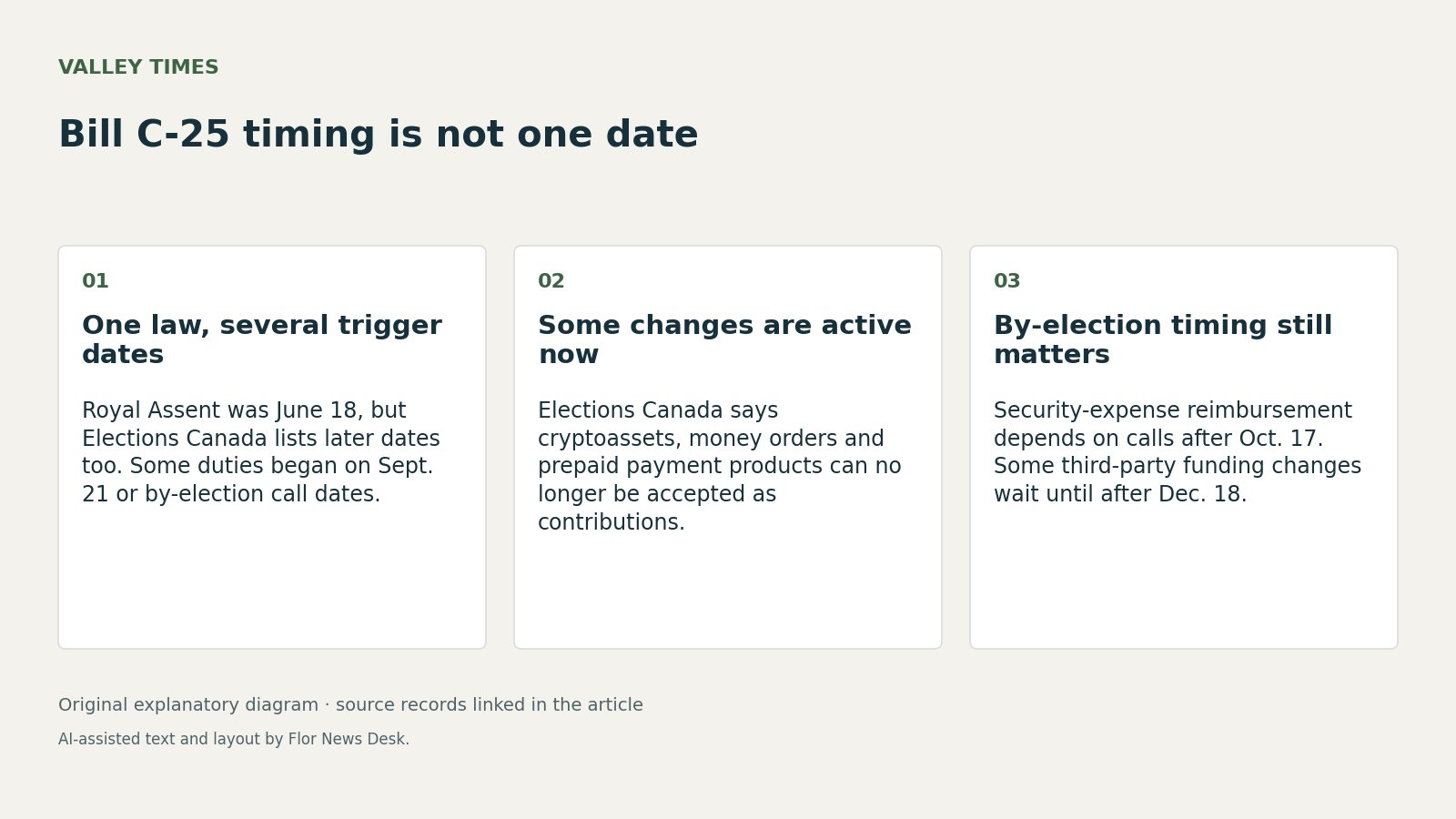

Elections Canada’s October 17 guidance turns Bill C-25 into a practical timing story, not a single-date story. Bill C-25, the Strong and Free Elections Act, received Royal Assent on June 18, 2026, and the federal government published its announcement on June 19, 2026. But Elections Canada says some obligations for political entities took effect on June 18, some on September 21, and some depend on when a by-election is called, including dates after October 17 and December 18. That matters nationally because compliance now depends less on the bill’s headline and more on which legal trigger fits a party, candidate or third party’s situation. (Government of Canada release, Elections Canada guidance)
The federal government’s June 19 release frames the law as a package of amendments meant to strengthen election protections, including privacy requirements, limits on anonymous and foreign funding, enforcement changes, nomination and leadership contest protections, deepfake-related measures and steps meant to address long ballots. But that release does not set out section-by-section commencement details or administrative procedures. The more useful record for immediate compliance is Elections Canada’s updated guidance page, which shows that Royal Assent did not make every operational rule equally active on the same timetable. (Government of Canada release, Elections Canada guidance)
Some changes are immediate and concrete. Elections Canada says political entities can no longer accept contributions in cryptoassets, money orders or prepaid payment products. It also says those contributions must be returned, destroyed, or converted into money and remitted, with the action declared on form EC 20025. Separately, Elections Canada says that, as of September 21, 2026, a registered party’s website privacy policy must include basic safeguards for personal data and prohibit certain uses of that data. Those are not abstract policy goals in the records here; they are operational instructions tied to specific dates. (Elections Canada guidance)
The same page also shows why readers should be careful with broad claims that “the new rules are in force.” Elections Canada says candidates in the same electoral district and election cannot share an official agent, and one person cannot serve as official agent for more than one candidate in that district and election. For by-elections called after October 17, 2026, Elections Canada says an eligible candidate’s personal security expenses are reimbursable at 65 per cent, to a maximum reimbursement of $3,250, with that maximum reached by spending $5,000. (Elections Canada guidance)
The biggest analytical point is that a by-election’s call date can change which version of the law applies. Elections Canada says the new third-party funding rules listed under “rule changes not yet applicable” do not apply to by-elections called before December 18, 2026, and that the previous rules apply in those cases. In other words, passage of Bill C-25 did not erase the old regime overnight for every electoral event. A campaign team or civic group asking what applies now needs a date matrix, not a yes-or-no answer. (Elections Canada guidance)
There is also a real implementation limit in the public record used here. Elections Canada says political financing handbooks, reporting forms and FAQs are still being updated. Its page shows an October 17 update date, but not an original publication date, and it is an information page rather than the full statute or an enforcement ruling. So the safest reading is narrow: the records establish several specific rule changes and trigger dates, but they do not establish that every promised reform described by the federal government has already been translated into final forms, guidance or enforceable day-to-day practice in the same way. (Elections Canada guidance, Government of Canada release)