Canada’s recent housing affordability improvement may be more fragile than a single national average suggests. In a September 10, 2026 release tied to its Fall 2026 Housing Supply Report, Canada Mortgage and Housing Corporation said rental supply is expanding, but homeownership construction is slowing enough to threaten those gains. A September 29, 2026 CMHC explainer on its Canadian Rental Housing Development Survey points in the same direction: developers still see rental demand, but they also report delays, fees, market conditions and construction costs that can slow projects. CMHC news release, Sept. 10, 2026 CMHC rental survey explainer, Sept. 29, 2026
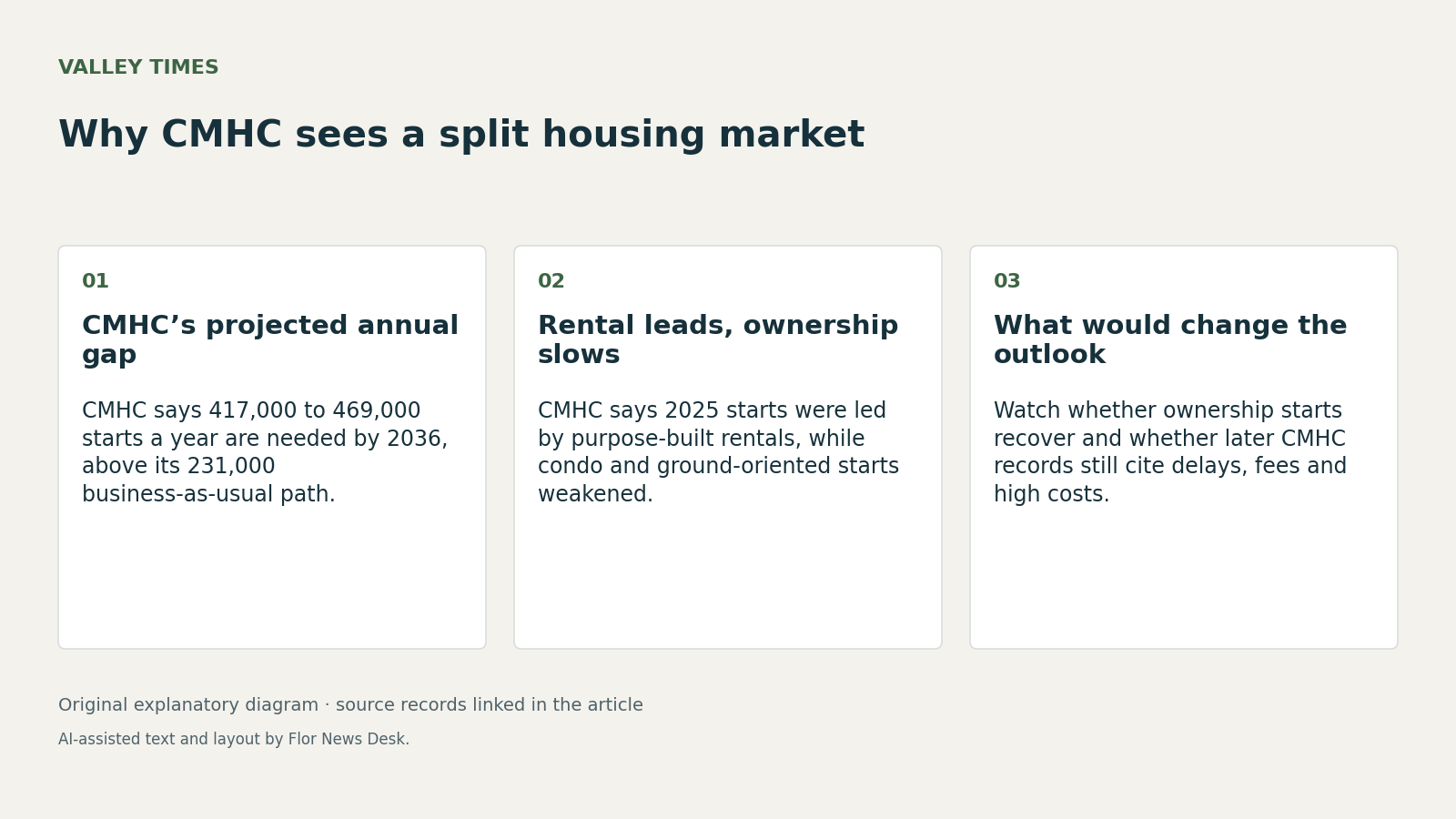
CMHC’s main national estimate is a projection, not a completed outcome or funding result. The agency says Canada would need 417,000 to 469,000 housing starts a year to return to 2019 affordability levels by 2036. Its business-as-usual path is 231,000 starts a year, leaving an annual gap of 187,000 to 238,000 homes. CMHC also says that national gap is broadly unchanged from its 2025 assessment, even though city patterns differ, with Toronto narrower, Vancouver unchanged, Ottawa and Montréal wider, Calgary narrower, and Edmonton showing no measurable gap. Fall 2026 Housing Supply Report CMHC news release, Sept. 10, 2026
The sharper signal is not just the size of the gap, but the type of homes being added. CMHC says supply growth in major markets is increasingly coming from projects already under construction while new project launches have weakened. In the major markets grouped by CMHC, 2025 starts were 69,475 purpose-built rental units, compared with 34,259 condominium apartment units and 43,967 ground-oriented units. That means the current pipeline improving options for renters is not matched by similar momentum in homes aimed at ownership. Fall 2026 Housing Supply Report
The September 29 survey explainer helps show why rental building has kept moving. CMHC says purpose-built rental construction is at an all-time high, more than half of respondents expected strong rental demand over the next five years and beyond, and only about 10% reported increased financing challenges. But the same record says approval delays, government fees, market conditions and elevated construction costs are still slowing projects. CMHC also says more developers are using a develop-and-hold approach, some are shifting to 30-year amortization from 25 years, and interest in modern methods of construction rose to about 45% from roughly one-fifth in the prior survey. CMHC rental survey explainer, Sept. 29, 2026
Taken together, those September records describe a split market rather than a simple recovery. Analysis: renter conditions can improve for a period when a large wave of purpose-built rental projects reaches market, even while the ownership pipeline thins. If condominium and ground-oriented launches stay weak, that later limits homes available for purchase if demand strengthens again. That is the practical meaning of CMHC’s warning that added rental supply may help move rental markets toward balance while leaving a future ownership crunch unresolved. Fall 2026 Housing Supply Report CMHC news release, Sept. 10, 2026
The next useful test is whether the mix of starts changes, not whether one September warning sounded severe. If ownership-oriented starts continue lagging rental starts, CMHC’s projected supply gap becomes harder to close. If later CMHC records keep showing approval delays, fees and construction costs as barriers, that would suggest financing access alone is not the central explanation. Fall 2026 Housing Supply Report CMHC rental survey explainer, Sept. 29, 2026
There are important limits to these records. The Housing Supply Report sets out CMHC estimates and projections over time, and the retrieved report page does not provide the full methodology needed to test those assumptions from the page alone. The September 29 survey page is a CMHC explainer and podcast transcript, and the retrieved record does not include sample size, response rate or full survey method. So the documents support a clear national warning, but they do not establish a verified October 2026 outcome on whether the slowdown has reversed or whether affordability gains have held. Fall 2026 Housing Supply Report CMHC rental survey explainer, Sept. 29, 2026